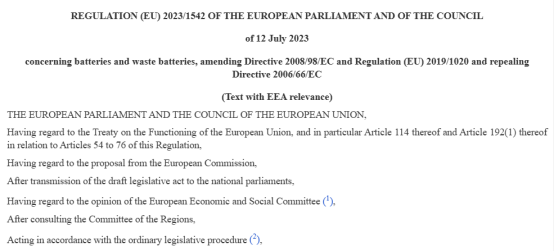
The European Commission has announced the implementation of new regulations for a range of battery-containing products in multiple regional markets, in alignment with the EU’s Extended Producer Responsibility (EPR) requirements. As of today, the new EU Battery Regulation (EU 2023/1542) has officially come into force, replacing the previous 2006/66/EC Directive and imposing stricter compliance obligations on businesses selling batteries or battery-integrated products in the European Union.
The regulation covers most types of batteries, including:
l Single-use batteries
l Rechargeable batteries
l Automotive batteries (covering transport and electric vehicles)
This applies both to batteries sold as standalone products and those integrated into other goods.
Amazon EPR Enforcement Timeline and Affected Platforms
Starting August 18, 2025, Amazon will begin enforcing battery-related EPR requirements across several regional markets. The affected markets include:
Belgium, France, Germany, Italy, the Netherlands, Poland, Spain, Sweden, and Ireland.
All product listings identified as containing batteries must be associated with a valid EPR registration number for the respective country of sale. If you sell in multiple regions, a valid EPR registration number must be uploaded for each one.
Additional EU Compliance Requirements: CE Marking and Authorized Representative
The EU has mandated that all battery-containing products must also undergo additional product testing and obtain CE certification.
Selling battery-equipped goods in the EU without proper CE marking is illegal - even if you hold a valid EPR registration.
Businesses not established in the EU are also required to appoint an Authorized Representative.
Consequences of Non-Compliance with the Battery EPR Regulation
Sellers who fail to upload a valid EPR registration number will be subject to measures by Amazon to ensure adherence to local regulations.
Sellers on Amazon France and Amazon Spain will be automatically enrolled in a “Pay-on-Behalf” service - an additional paid service where Amazon will handle EPR declarations on the seller’s behalf for a fee.
Sellers in all other regional markets may face enforcement actions, including:
l Removal of product listings (including associated ASINs)
l Suspension of selling privileges - either regionally or across all Amazon marketplaces
Sellers who fail to obtain CE certification (and appoint an Authorized Representative, if required) will be subject to national enforcement measures, such as:
l Seizure and/or destruction of goods at customs
l Financial penalties, including confiscation of revenue
Summary of Key Content
Scope of Application
The regulation applies to all types of batteries, including:
l Portable batteries (e.g., AA, AAA, mobile phone batteries)
l Light Means of Transport (LMT) batteries (e-bikes, scooters, etc.)
l SLI batteries (starting, lighting, and ignition batteries for vehicles)
l Industrial batteries (large equipment, telecom base stations, etc.)
Core Compliance Requirements
1, Extended Producer Responsibility (EPR)
l Registration obligation: Producers or first sellers of batteries in the EU must register for EPR in each country where they sell and submit the registration number to e-commerce platforms (e.g., Amazon, eBay, Temu).
l Financial responsibility: Cover costs related to the collection, recycling, and environmentally sound disposal of waste batteries.
l Authorized Representative (AR): Non-EU companies must appoint a local AR (e.g., Germany requires AR binding; otherwise, the registration becomes invalid).
2, Labeling and Identification
l Crossed-bin symbol (indicating improper disposal is prohibited)
l Chemical identification (e.g., “Li” for lithium)
l QR code (for digital product information)
l CE marking (batteries and battery-integrated products must comply with CE certification).
3, Battery Passport (Mandatory from 2027)
Electric vehicle and industrial batteries (>2kWh) must provide a digital battery passport containing information on performance, composition, and origin.
Key Timeline
l August 18, 2025: EPR registration takes effect; non-compliant products may be delisted.
l From 2025: Carbon footprint disclosure required for electric vehicle and industrial batteries.
l 2027: Portable batteries must be designed for user replacement; LMT batteries must be replaceable by professionals.
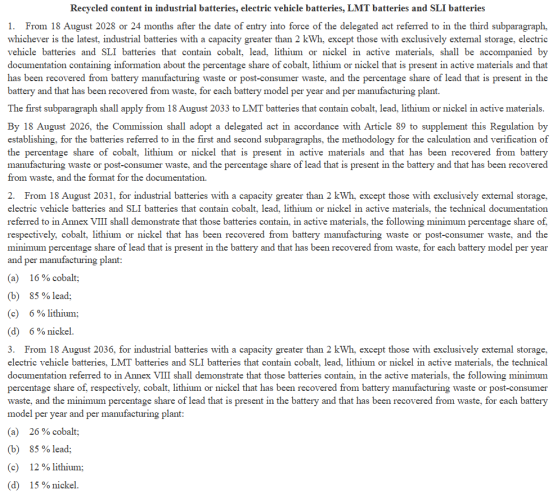
l From 2031: Minimum recycled content standards apply (e.g., cobalt 16%, lithium 6%, lead 85%).
Country-Specific Requirements
l Germany: Registration numbers must be linked to an Authorized Representative (AR); otherwise, they become invalid.
l Netherlands: Failure to register may result in loss of Pan-EU FBA benefits (e.g., subsidies).
l Poland: Registration under both Packaging Law (BDO) and Battery Law (PRO organization) is required.
l Ireland: Registration for both WEEE and Battery Law is mandatory.
l France/Belgium: Platforms may deduct eco-fees on behalf of sellers (15% service fee in France, 8% in Belgium).
Recommended Actions for Sellers
1. Initiate EPR registration immediately (process takes 1–2 months; start as soon as possible).
2. Upload registration numbers to e-commerce platforms (e.g., via Amazon’s “Regulatory Compliance” or “Submit Compliance Information”).
3. Ensure labeling compliance (CE marking, recycling symbols, etc.).
4. Establish a recycling system or join a Producer Responsibility Organization (PRO).
The EU’s new Battery Regulation strengthens producer responsibility and requires comprehensive compliance. Non-compliant businesses may face market access restrictions. Sellers are advised to complete registrations promptly and stay informed about country-specific requirements to ensure uninterrupted operations.
Detailed link to the bill: https://eur-lex.europa.eu/eli/reg/2023/1542/oj
