The General Safety Regulation for vehicles published by the European Union on July 13, 2009, (EC) No 661/2009, "concerning type-approval requirements for the general safety of motor vehicles, their trailers, and systems, components, and separate technical units intended for such vehicles," marked another major reform of the EU's technical directive system for automotive products and type-approval mechanism. This development followed the implementation of the new whole vehicle type-approval framework under Directive 2007/46/EC (which is set to be replaced by (EU) 2018/858).
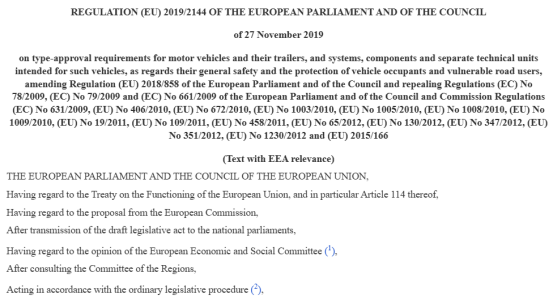
The new Regulation (EU) 2019/… "concerning type-approval requirements for the general safety of motor vehicles, their trailers, and systems, components, and separate technical units intended for such vehicles, and the protection of vehicle occupants and vulnerable road users" will replace the old Regulation EC 661/2009 and repeal a series of related regulations.
1, The new Regulation (EU) 2019/… focuses on both active and passive safety.
1.1 It introduces new UN Regulations concerning occupant protection, such as UN Regulation No. 135, Series 01 (Pole Side Impact) and UN Regulation No. 137, Series 01 (Full-Width Frontal Impact), among others.
1.2 As vehicle designers increasingly prioritize maximizing space for occupants and cargo, the direct vision systems for trucks and buses have been affected. In response, the new Regulation (EU) 2019/… imposes updated requirements on heavy-duty vehicle direct vision systems. These aim to enhance the driver's direct visibility of pedestrians and cyclists around the cab, minimize blind spots to the front and sides, and facilitate eye contact between drivers and vulnerable road users to mutually confirm awareness.
1.3 Additionally, the regulation sets out requirements for the installation of alcohol interlock devices and the implementation of driver drowsiness and attention detection systems. Standards for alcohol interlock interfaces, along with requirements for monitoring and detecting driver fatigue and inattention, are intended to ensure that drivers remain alert while operating vehicles, thereby improving road safety.
2, The New Regulation (EU) 2019/… Focuses on Autonomous Driving Technology.
The draft of the new Regulation (EU) 2019/… lays the legal groundwork for the introduction of autonomous vehicles by setting requirements for "driver readiness monitoring systems," "systems substituting driver control," and "systems monitoring the vehicle’s surroundings."
Speed has long been recognised as one of the three major contributing factors to fatalities on roads. The draft regulation includes specific requirements for Intelligent Speed Assistance (ISA) systems, stipulating that the ISA must be capable of being overridden or switched off in situations such as adverse weather, temporarily conflicting road signs in construction zones, or misleading/defective/missing speed limit signage. By retaining an element of human control, the system aims to enhance road safety. ISA is a driver assistance technology, and a 2014 Norwegian study identified it as one of the "most effective" life-saving measures.
ISA uses speed sign recognition cameras and/or GPS-linked speed limit data to inform drivers of the current limit and automatically restricts the vehicle’s speed as needed. Unless the current speed limit is exceeded, the ISA system does not apply automatic braking but instead limits engine power to prevent the vehicle from accelerating beyond the set limit. In the European market, vehicles equipped with ISA are already available - due in large part to Euro NCAP’s decision to award additional safety points to models featuring this technology.
Detailed link to the bill: https://eur-lex.europa.eu/eli/reg/2019/2144/oj
